|
1
|
- Some material borrowed from lectures of J. Demmel, UC Berkeley
|
|
2
|
- Embarrassingly parallel computations
- ‘ideal case’. after perhaps some initial communication, all processes
operate independently until the end of the job
- examples: computing pi; general Monte Carlo calculations; simple
geometric transformation of an image
- static or dynamic (worker pool) task assignment
|
|
3
|
- Partitioning
- partition the data, or the domain, or the task list, perhaps
master/slave
- examples: dot product of vectors; integration on a fixed interval;
N-body problem using domain decomposition
- static or dynamic task assignment; need for care
|
|
4
|
- Divide & Conquer
- recursively partition the data, or the domain, or the task list
- examples: tree algorithm for N-body problem; multipole; multigrid
- usually dynamic work assignments
|
|
5
|
- Pipelining
- a sequence of tasks performed by one of a host of processors;
functional decomposition
- examples: upper triangular linear solves; pipeline sorts
- usually dynamic work assignments
|
|
6
|
- Synchronous Computing
- same computation on different sets of data; often domain decomposition
- examples: iterative linear system solves
- often can schedule static work assignments, if data structures don’t
change
|
|
7
|
- Determined by
- Task costs
- Task dependencies
- Locality needs
- Spectrum of solutions
- Static - all information available before starting
- Semi-Static - some info before starting
- Dynamic - little or no info before starting
- Survey of solutions
- How each one works
- Theoretical bounds, if any
- When to use it
|
|
8
|
- Large literature
- A closely related problem is scheduling, which is to determine the order
in which tasks run
|
|
9
|
- Tasks costs
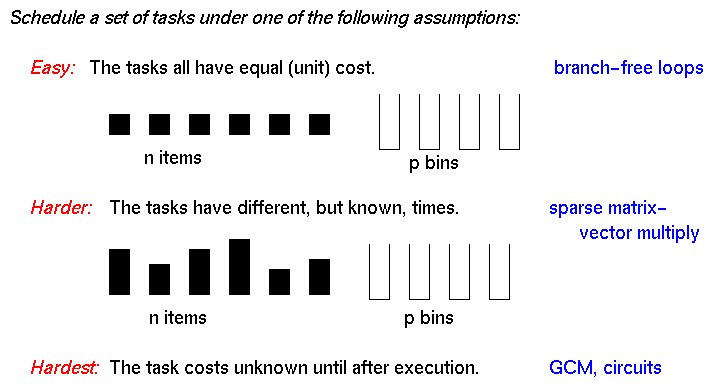
- Do all tasks have equal costs?
- Task dependencies
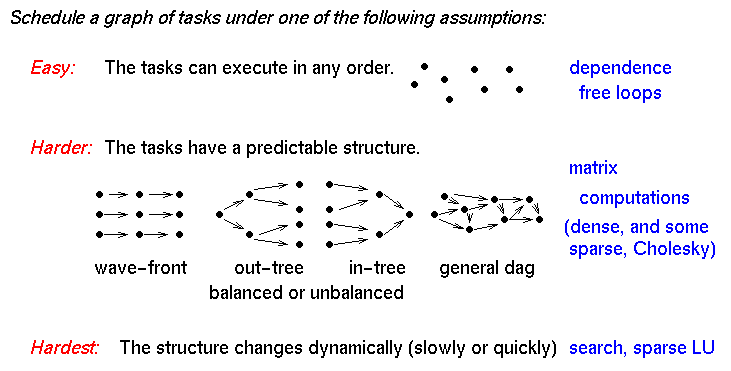
- Can all tasks be run in any order (including parallel)?
- Task locality
- Is it important for some tasks to be scheduled on the same processor
(or nearby) to reduce communication cost?
|
|
10
|
|
|
11
|
|
|
12
|
|
|
13
|
- Static load balancing
- Semi-static load balancing
- Self-scheduling
- Distributed task queues
- Diffusion-based load balancing
- DAG scheduling
- Mixed Parallelism
|
|
14
|
- All information is available in advance
- Common cases:
- dense matrix algorithms, e.g. LU factorization
- done using blocked/cyclic layout
- blocked for locality, cyclic for load balancing
- usually a regular mesh, e.g., FFT
- done using cyclic+transpose+blocked layout for 1D
- sparse-matrix-vector multiplication
- use graph partitioning, where graph does not change over time
|
|
15
|
- Domain changes slowly; locality is important
- use static algorithm
- do some computation, allowing some load imbalance on later steps
- recompute a new load balance using static algorithm
- Particle simulations, particle-in-cell (PIC) methods
- tree-structured computations (Barnes Hut, etc.)
- grid computations with dynamically changing grid, which changes slowly
|
|
16
|
- Self scheduling:
- Centralized pool of tasks that are available to run
- When a processor completes its current task, look at the pool
- If the computation of one task generates more, add them to the pool
- Originally used for:
- Scheduling loops by compiler (really the runtime-system)
|
|
17
|
- A set of tasks without dependencies
- can also be used with dependencies, but most analysis has only been
done for task sets without dependencies
- Cost of each task is unknown
- Locality is not important
- Using a shared memory multiprocessor, so a centralized pool of tasks is
fine
|
|
18
|
- Don’t grab small unit of parallel work.
- Chunk of tasks of size K.
- If K large, access overhead for task queue is small
- If K small, likely to have load balance
- Four variations:
- Use a fixed chunk size
- Guided self-scheduling
- Tapering
- Weighted Factoring
|
|
19
|
- How to compute optimal chunk size
- Requires a lot of information about the problem characteristics e.g.
task costs, number
- Need off-line algorithm; not useful in practice.
- All tasks must be known in advance
|
|
20
|
- Use larger chunks at the beginning to avoid excessive overhead and
smaller chunks near the end to even out the finish times.
|
|
21
|
- Chunk size, Ki is a function of not only the remaining work,
but also the task cost variance
- variance is estimated using history information
- high variance => small chunk size should be used
- low variant => larger chunks OK
|
|
22
|
- Similar to self-scheduling, but divide task cost by computational power
of requesting node
- Useful for heterogeneous systems
- Also useful for shared resource e.g. NOWs
- as with Tapering, historical information is used to predict future
speed
- “speed” may depend on the other loads currently on a given processor
|
|
23
|
- The obvious extension of self-scheduling to distributed memory
- Good when locality is not very important
- Distributed memory multiprocessors
- Shared memory with significant synchronization overhead
- Tasks that are known in advance
- The costs of tasks is not known in advance
|
|
24
|
- Directed acyclic graph (DAG) of tasks
- nodes represent computation (weighted)
- edges represent orderings and usually communication (may also be
weighted)
- usually not common to have DAG in advance
|
|
25
|
- Two application domains where DAGs are known
- Digital Signal Processing computations
- Sparse direct solvers (mainly Cholesky, since it doesn’t require
pivoting).
- Basic strategy: partition DAG to minimize communication and keep all
processors busy
- NP complete, so need approximations
- Different than graph partitioning, which was for tasks with
communication but no dependencies
|
|
26
|
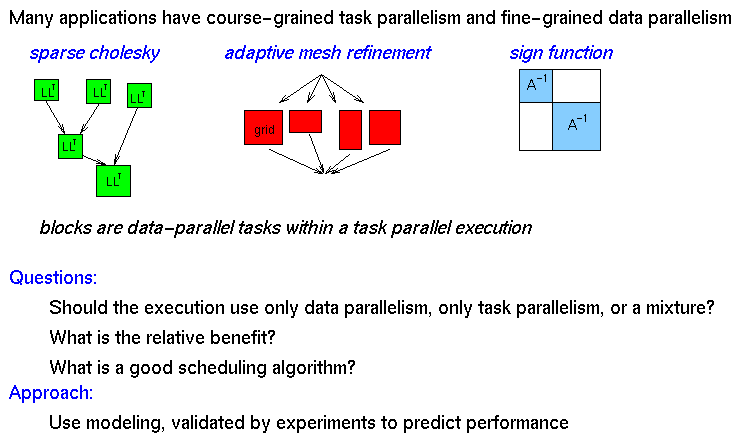
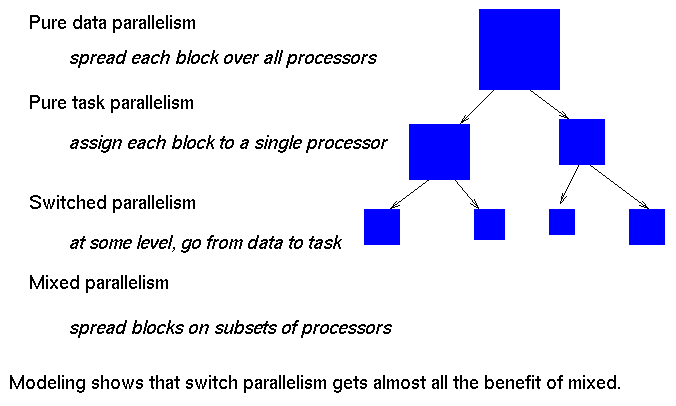
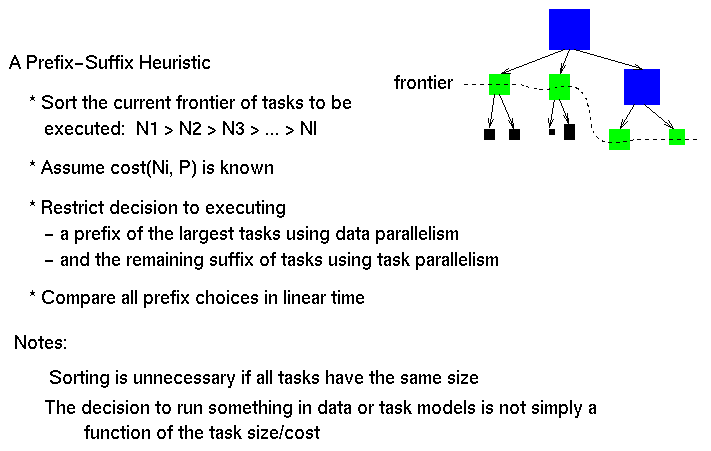
- Another variation - a problem with 2 levels of parallelism
- course-grained task parallelism
- good when many tasks, bad if few
- fine-grained data parallelism
- good when much parallelism within a task, bad if little
|
|
27
|
- Adaptive mesh refinement
- Discrete event simulation, e.g., circuit simulation
- Database query processing
- Sparse matrix direct solvers
|
|
28
|
|
|
29
|
|
|
30
|
|
|
31
|
|
|
32
|
|

 Notes
Notes